
How to Make a Mobile Game With AI in 2026 (No Code) 🎮
Ten years ago, shipping a mobile game meant Unity, C# and an artist on retainer. In 2026 you can describe the game in plain language and watch it get built, engine included. Here is the honest path from one sentence to a game on the App Store: the six steps, five real games made this way, the tools compared, and what it actually costs.
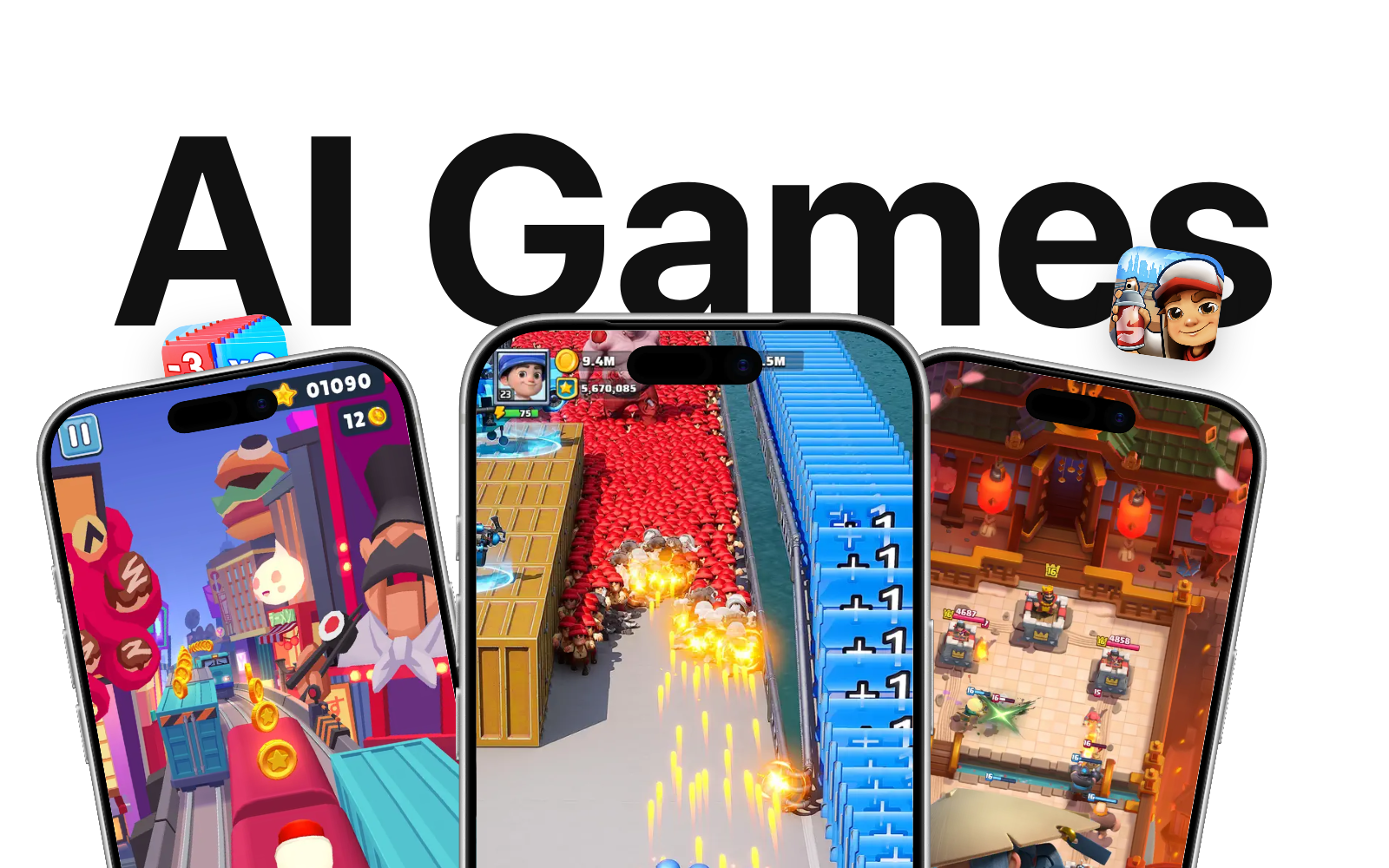
Making a mobile game used to be the hardest thing you could attempt without a team. You needed an engine, a language, an artist, a sound designer, and the patience to wire all four together. In 2026, an AI game builder takes a description written in plain language and returns a playable build, engine included.
This guide is the practical path: what AI can and cannot build today, the six steps from prompt to App Store, five real games created this way (with clips), the tools compared, and the real cost.
In short
To make a mobile game with AI: describe your game in plain language to an AI game builder, let it generate a playable first level, then ask for changes until the core loop is fun. Add sound, a HUD and monetization, then submit to the App Store. No code required, and the first playable build takes minutes, not months.
Contents
- Can AI really make a mobile game in 2026?
- What to decide before you write a single prompt
- How to make a mobile game with AI in 6 steps
- Five real games built with AI
- AI game tools compared
- Mistakes that kill an AI-made game
- What it costs
- The verdict
- Frequently asked questions
Can AI really make a mobile game in 2026?
Yes, with one honest caveat. Today's models write the game's actual code: the render loop, the collision math, the enemy pathfinding, the HUD. That is a real shift from the previous generation of no-code tools, where you assembled a game out of pre-made blocks and inherited every limit of the block library.
The caveat is that AI removes the engineering, not the game design. It will build exactly the loop you describe. If the loop is boring, you get a working, boring game, delivered very fast. The work that remains is the work that always mattered: deciding what the player does in the first thirty seconds, and why they would do it again.
What works well today: single-player mobile formats. Racing, first-person shooters, endless runners, crowd runners, platformers, voxel worlds, city builders, board and puzzle games. What does not: massive multiplayer worlds, competitive online shooters, and forty-hour narrative RPGs. Those still need a studio.
What to decide before you write a single prompt
Five minutes here saves an afternoon later. Write down four things.
Your core loop, in one sentence. "Drive three laps and beat six rivals." "Dig, build, survive the night." If you cannot fit it in a sentence, the AI will not guess it either.
The camera. First person, third person behind the player, side view, or top down. This single choice decides most of how the game feels.
The win and lose condition. A game with no way to fail is a toy. A timer, a health bar, a finish line, three lives: pick one before you start.
One look. Neon city at night, pastel low-poly, blocky voxel, hand-drawn. Naming an art direction up front keeps every later addition visually coherent.
How to make a mobile game with AI in 6 steps
1. Describe the game, not the code
Write the four decisions above as a plain description. Do not explain how to implement anything. A prompt that produces a good first build looks like this:
A 3D racing game set in a neon city at night.
Three laps on a circuit with two shortcuts.
Six AI opponents that stay close instead of running away.
HUD: speedometer, lap timer, position.
Tilt to steer, one button to boost.
Five lines, no jargon. On Bloxks Game, that description is enough to pick the engine, build the track, spawn the rivals and wire the controls.
2. Let it pick the engine
2D, 3D or voxel is a technical decision that follows from your description, and a good AI builder makes it for you. A racing game in a city needs a 3D engine with real physics; a Minecraft-style world needs a voxel engine with chunk streaming; a match-three needs neither. Choosing wrong here is the single most expensive mistake in game development, and it is the one you no longer have to make yourself.
3. Play the first build immediately
The first playable version usually lands in minutes. Play it on your phone before you read a line of what was generated. You are looking for one thing only: is the core loop fun for thirty seconds? Everything else, art, sound, menus, is fixable later. A dull loop is not.
4. Iterate in plain language
This is where a game is actually made. You do not open an editor, you ask:
- "The opponents are too easy after lap one, make them stay within two seconds of me."
- "Add a boost pad on the shortcut and a spark trail when it triggers."
- "The camera is too close in corners, pull it back and add a bit of lag."
Each request produces a new playable build. Ten to thirty of these turns a demo into a game. Rebalancing enemies used to be an afternoon of tuning constants by hand; here it is one sentence.
5. Dress it: HUD, sound, 3D assets
A game that plays well still loses players in the first screen if it looks unfinished. Three additions do most of the work: a HUD that shows score, lives and progress; sound effects on every action the player takes; and real 3D models instead of coloured boxes. On Bloxks you can drop your own .glb model into the world, and rigged characters get their animation clips detected automatically, so a hero walks and runs without you touching a timeline.
6. Publish and monetize
The last mile is where most first games die, and none of it is game design. You need an icon, screenshots taken inside your real game, the right App Store game sub-category, an age rating that matches your actual gameplay, and in-app purchases wired to a real billing system. Bloxks generates all of it and submits to the App Store and Google Play from the same screen. If you want the full submission checklist, our guide on building a mobile app without a developer covers the store side in detail.
Five real games built with AI
These are not mockups. Each clip is a real build made from a description on Bloxks Game, running on a phone.
Racing: a night circuit with rubber-band rivals

Racing game built with Bloxks Game
Lap counter, best-lap timer, speedometer, position, drift on the corners and a boost button. The opponents are tuned to stay near the player rather than vanish ahead, which is the difference between a race and a solo time trial.
Crowd runner: the format that owns the top charts
Crowd runner built with Bloxks Game
Multiplier gates, a growing army, weapon upgrades that change the projectile, and enemy squads to wipe out. This genre dominates casual charts because the reward loop is visible every three seconds, and it is one of the easiest to describe to an AI: "my crowd grows at gates and fights enemy crowds."
Voxel: a Minecraft-style world you can dig
Voxel world built with Bloxks Game
Block breaking and placing, an inventory bar, a health bar, creatures to avoid. A voxel world is the clearest proof that the engine is real: chunks stream in as you walk, and every block you remove changes the mesh underneath.
First-person shooter: aiming, weapons, collisions
FPS built with Bloxks Game
Twin-stick touch controls, weapons with distinct fire rates, walls that actually block bullets, enemies that path around obstacles instead of walking into them. This is the genre where a fake engine shows immediately, because bad collisions are impossible to hide.
City builder: placement, economy, growth
City builder built with Bloxks Game
Grid placement, a resource economy and roads that connect what you build. Management games are a great fit for AI generation because their rules are verbal by nature: "a house needs a road and produces two coins per cycle."
More formats, including the platformer and the endless runner, are playable on the Bloxks Game page.
AI game tools compared
| Tool | Best for | Output | Where it publishes |
|---|---|---|---|
 Bloxks Game Bloxks Game |
Prompt to published mobile game | Real React + three.js code | App Store and Google Play, built in |
| GDevelop | 2D games, visual event editor | Its own project format | Web, Android, iOS, Steam |
| Buildbox | Drag-and-drop 2D and 3D | Its own project format | App Store, Google Play |
| Unity + AI assistant | Teams who already ship games | C# project | Everywhere, with setup |
| Roblox Build | Games that live inside Roblox | Roblox experience | Roblox only |
The dividing line that matters is not how good the AI is at writing code. It is what you own at the end. A tool that outputs a real codebase and hands you the store submission leaves you with a product; a tool that keeps your game inside its own player leaves you with a page on someone else's platform. For a wider view of AI builders beyond games, see our top 10 platforms to build iOS apps.
Mistakes that kill an AI-made game
- Describing a universe instead of a loop. "An epic RPG in a vast fantasy world" produces nothing playable. "Fight three waves of skeletons in an arena, one sword, one dodge" produces a game you can improve.
- Skipping the thirty-second test. If you do not play the first build immediately, you will spend hours polishing a loop that was never fun.
- Adding features instead of tuning the loop. A second weapon does not fix bad enemies. Tune difficulty, speed and feedback first.
- Silence. A game with no sound feels broken even when it plays perfectly. Sound effects are the cheapest quality upgrade you will make.
- Treating the store as an afterthought. Wrong sub-category, an age rating that does not match the gameplay, and screenshots that are not from the game are the three most common rejection causes for first submissions.
- Shipping the demo. The first build is a prototype. Publish the version you have played twenty times, not the one you just generated.
What it costs
| Item | Price |
|---|---|
| Apple Developer account | $99 per year |
| Google Play developer account | $25, one time |
| AI game builder | Free to about $25 per month |
| Same game via a studio | Tens of thousands, and up |
The economics are the real story. A polished casual mobile game quoted by an agency starts in the tens of thousands and takes months. The AI path costs about the price of a monthly subscription plus the store fees, and the loop from idea to playable is short enough that you can afford to be wrong twice before you find the game worth publishing.
Once it is live, monetization is the same as any other mobile game: in-app purchases for coins, skins or lives, a subscription, or rewarded ads. Bloxks wires the paywall through RevenueCat so the products exist and are tracked from the first version rather than bolted on after launch.
The verdict
AI has removed the part of game development that stopped most people: the engineering. It has not removed the part that decides whether anyone plays: the loop. Use that trade. Spend the fifteen minutes you save on code deciding what the player does in the first thirty seconds, describe it precisely, then iterate until it is fun.
The rest, physics, enemies, HUD, icon, screenshots, age rating, store submission, is handled. Describe your game on Bloxks Game and play the first build today.
Frequently asked questions
Can you really make a mobile game with AI without coding?
Yes. You describe the game in plain language and the AI writes the engine, the physics, the enemies and the interface. With a tool like Bloxks Game the output is real React and three.js code, so the result is a genuine app you can publish, not a browser demo locked inside a platform.
How long does it take to make a mobile game with AI?
A first playable level usually appears in a few minutes. Turning that into a game worth publishing, with progression, sound, a store listing and monetization, is normally an afternoon of back and forth. The bottleneck is no longer the code, it is deciding what makes your loop fun.
What does it cost to publish a mobile game in 2026?
Apple charges $99 per year for a developer account and Google Play a one-time $25. On top of that, an AI game builder runs from free to about $25 per month. A traditional studio build for the same game starts in the tens of thousands.
What kinds of games can AI build today?
Single-player mobile formats work best: racing, first-person shooters, endless and crowd runners, platformers, voxel worlds, city builders, puzzle and board games. Large multiplayer worlds, competitive online shooters and long narrative RPGs are still out of reach for a one-prompt build.
Will Apple reject a game made with AI?
Apple does not reject a game for being AI-assisted. It rejects games that are empty, broken, or a repackaged website. Ship a real playable loop, a correct age rating and screenshots from your actual game, and an AI-built game goes through review like any other.