
16 App Founders Who Started With One App (Real Revenue, 2026)
Most “app founder success stories” are undated lists with round numbers nobody can check. This one is different: 16 founders, one app each to start, and for every revenue figure, who said it and when. Some are teenagers, some are solo makers, some raised hundreds of millions. Here is what really happened, and what you can take from it.
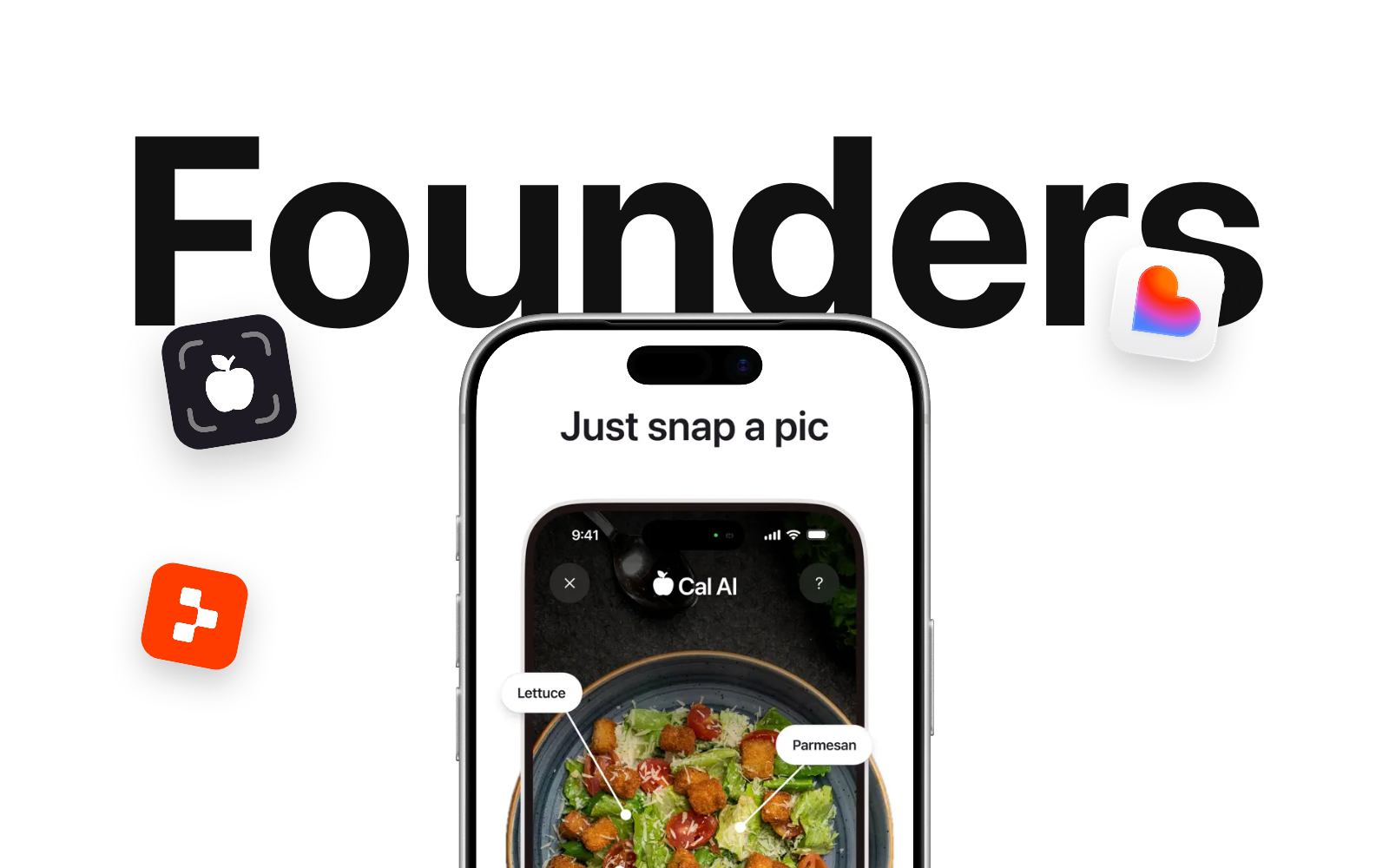
These 16 app founders started with one app: one idea, one product, one launch. Some got rich, some sold, some are still building alone. What they share is not luck or a famous co-founder. It’s a narrow use case, a fast launch and a distribution channel they understood better than anyone. Below, each story comes with the numbers and where they come from.
In short
- 16 founders, from a 17-year-old high schooler (Zach Yadegari, Cal AI) to French teams behind Yuka, BeReal and PhotoRoom.
- Every revenue figure is sourced and dated, and marked as reported, claimed or estimate.
- Four profiles: teens who shipped AI apps, solo makers, AI builder founders, French founders.
- The common thread: one use case, shipped fast, with distribution planned from day one.
Contents
- How we picked the founders and sourced the numbers
- The 16 founders at a glance
- Teens and students who shipped AI apps
- Solo makers who never raised
- The founders behind AI app builders
- French founders: Yuka, BeReal, PhotoRoom
- What these app founders have in common
- Your turn: start with one app
How we picked the founders and sourced the numbers
We kept founders whose story starts with one product that took off, and who are still visible enough to be checked. That gives a mix of consumer mobile apps (Cal AI, Yuka, BeReal, PhotoRoom), web products from solo makers, and the AI builders that let non-coders create apps.
For revenue, we did not average or round anything. Each figure comes from the full profiles on Bloxks Founders, with its source and date. Three markers tell you how much to trust it:
- Reported: published by the press or in a company statement.
- Claimed: announced by the founder, not audited.
- Estimate: calculated by a third party (a teardown, an analytics firm).
When public figures conflict, we say so. Cal AI is the best example: the founder speaks of about $40M in sales over 12 months, while MyFitnessPal told TechCrunch in March 2026 that the app makes “over $30 million in annual revenue”. Both can be true depending on the period and on what counts as revenue.
The 16 founders at a glance
| Founder | App | Age at launch | Launch | Starting point | Revenue (marker, date) |
|---|---|---|---|---|---|
| Zach Yadegari | Cal AI | 17 | 2024 | High schooler, coding for 7 years | ~$40M/yr, $50M ARR at sale (reported, Mar. 2026) |
| Blake Anderson | RizzGPT, Umax, Cal AI | 22–23 | 2023 | Student, couldn’t code, ~$200 | ~$10M cumulative (claimed, 2024–25) |
| Roy Lee | Cluely | 21 | 2025 | Suspended Columbia student | ~$5M ARR (estimate, after correction, Mar. 2026) |
| Anton Osika | Lovable | n/a | 2024 | Swedish engineer, ex-CERN | ~$400M ARR (reported, early 2026) |
| Amjad Masad | Replit | n/a | 2016 | Immigrant from Jordan, ex-Facebook | ~$300M ARR (reported, Dec. 2025) |
| Eric Simons | Bolt.new | n/a | 2024 | StackBlitz close to bankruptcy | ~$40M ARR (reported, Mar. 2025) |
| Maor Shlomo | Base44 | n/a | 2025 | Side project of a serial founder | ~$3.5M ARR, sold ~$80M (estimate, 2025) |
| Riley Brown | Vibecode | n/a | 2025 | AI content creator | Not disclosed (10K+ paying users) |
| Pieter Levels | Nomad List, PhotoAI | 26–27 | 2014 | Self-taught developer | ~$3M/yr portfolio (estimate, Nov. 2025) |
| Marc Lou | ShipFast | ~30 | 2023 | Laid off, ~$20K savings | ~$50K/mo portfolio (claimed, 2024–25) |
| Tony Dinh | TypingMind | ~28–30 | 2023 | Quit a Big Tech job | $45K–83K/mo portfolio (claimed, 2024) |
| Danny Postma | HeadshotPro | ~29 | 2023 | Former web marketer | ~$300K/mo (estimate, 2023–25) |
| Greg Isenberg | Late Checkout | n/a | 2020 | Serial founder, 3 exits | ~$10M/yr (estimate, Dec. 2024) |
| Matthieu Rouif | PhotoRoom | n/a | 2019 | French engineer, ex-GoPro/Apple | ~€50M ARR, profitable (reported, 2023–24) |
| Julie Chapon | Yuka | ~29–30 | 2017 | Ex-consultant, non-technical | ~$7M/yr, profitable (claimed, Dec. 2025) |
| Alexis Barreyat | BeReal | n/a | 2020 | Ex-video producer at GoPro | Weak; sold for ~€500M (reported, June 2024) |
“n/a” means the age was not made public. For App Store revenue estimates on thousands of other apps, see Bloxks Analytics.
Teens and students who shipped AI apps
The youngest founders on the list share one move: they took a single, everyday need and let an AI model do the hard part.
Zach Yadegari launched Cal AI in May 2024, at 17. You photograph your meal, the AI counts calories and macros. He was not a beginner: he had been coding for seven years and his site Totally Science already made six figures. His first marketing test cost about $2,000. Users’ TikTok videos carried the app to 5M downloads in 8 months, then more than 15M in under two years. MyFitnessPal bought it (deal closed in December 2025, announced in March 2026). It was his second exit.
Blake Anderson is the opposite profile. A business student at Tulane with about $200 and no coding skills, he asked ChatGPT to help him build his first apps: RizzGPT (flirting replies), then Umax (face analysis), then Cal AI as a co-founder. His distribution: micro-influencers paid around $50 each. He claims about $10M in cumulative sales across his portfolio, with no funding.
Roy Lee co-founded Cluely at 21 after being suspended from Columbia for a tool that helped people cheat at engineering interviews. Controversy brought attention, a $5.3M seed and a $15M Series A from a16z. It also came with a cost: in March 2026 he publicly admitted that the “$7M ARR” he had announced was a lie. The corrected figure is around $5M ARR. Cluely is a desktop tool, not a mobile app, but the lesson applies to everyone: only share numbers you can prove.
Solo makers who never raised
This group proves that one person can build a profitable business, as long as they keep shipping.
Pieter Levels challenged himself in 2014 to launch 12 startups in 12 months. Nomad List came out of it, followed by Remote OK and PhotoAI, an AI photo generator. Same simple stack (PHP, jQuery, SQLite), no employees, no investors. In November 2025, PhotoAI made about $132–138K a month and his whole portfolio is estimated at ~$3M a year.
Marc Lou is French. Laid off, depressed at his parents’ home, he left for Bali with about $20K in savings. In 2023 he launched ShipFast, a Next.js boilerplate to launch a SaaS in a few days. By January 2024 he had shipped 16 products in two years. His solo portfolio makes about $50K a month, which he shares openly.
Tony Dinh quit his Big Tech engineering job in Vietnam in 2021. TypingMind, a better interface for ChatGPT that you use with your own API key, hit #1 on Product Hunt for the day. He shared an average of $45K a month in February 2024, then around $83K a month by late 2024.
Danny Postma started as a web marketer, not an engineer. He sold his AI copywriting tool Headlime for about $1M less than 8 months after launch, then launched HeadshotPro in March 2023: selfies in, professional photos out. It is estimated at ~$300K a month, with more than 17M headshots generated, mostly through programmatic SEO.
Greg Isenberg is the community case. A serial founder with three exits, he built Late Checkout in 2020 as a self-funded holding of community-based businesses. His newsletter passed 158K subscribers. An unaudited teardown estimates Late Checkout at ~$10M a year.
The founders behind AI app builders
The next five founders didn’t build a consumer app. They built the tools that let non-coders create one, and their growth curves are among the fastest ever recorded.
Anton Osika, a Swedish ex-CERN engineer, started with an open-source project (gpt-engineer) before launching Lovable in late 2024. Lovable reached $4M ARR in 4 weeks, passed $100M in under a year and hit ~$400M ARR in early 2026, a European record, built from Stockholm.
Amjad Masad co-founded Replit in 2016. Rejected three times by Y Combinator before getting in, close to bankruptcy, he bet on an AI agent: ARR grew tenfold in 6 months, to about $300M by late 2025.
Eric Simons spent 7 years building WebContainers at StackBlitz before Bolt.new. Launched with a single tweet in October 2024, it went from $0 to $20M ARR in two months.
Maor Shlomo built Base44 alone as a side project in January 2025. It passed $1M ARR in three weeks, and Wix bought it in June 2025 for about $80M in cash plus earn-outs. He shared $25M with his team of 8.
Riley Brown grew an audience of 1.5M+ followers around AI tools before co-founding Vibecode, an iOS app that turns a description into a mobile app. It raised a $9.4M seed in August 2025 and passed 10K paying users. Revenue isn’t disclosed.
French founders: Yuka, BeReal, PhotoRoom
Three French apps reached a global audience with very different business models. We compare them in detail in Yuka, BeReal, PhotoRoom: French apps that started from nothing.
- Julie Chapon co-founded Yuka in 2017 with Benoît and François Martin, from a hackathon idea. Scan a barcode, get a health score from green to red. No ads, no brand partnerships, growth by word of mouth: 73M users in 2025 and about $7M a year, profitable, as stated by the founder.
- Alexis Barreyat launched BeReal in 2020 with Kévin Perreau: one notification a day, two minutes to post. It reached more than 40M users and won an App Store Award, but monetization stayed weak. Voodoo announced the acquisition for €500M in June 2024.
- Matthieu Rouif co-founded PhotoRoom in 2019 with Eliot Andres: a phone photo becomes a studio product shot. Profitable about a year after launch, ~€50M ARR in 2023, and a $43M Series B in February 2024 with 150M+ downloads.
What these app founders have in common
Looking at the 16 stories side by side, a few patterns repeat.
- One use case you can explain in a sentence. Snap a meal. Scan a product. Post once a day. Selfie to headshot. None of these apps tried to do everything.
- They shipped before it was perfect. Pieter Levels launched 12 products in 12 months; Marc Lou shipped 16 in two years. The hit came from volume.
- Distribution was part of the plan. TikTok creators for Cal AI and Blake Anderson’s apps, word of mouth for Yuka, campuses for BeReal, X audiences for the solo makers, SEO for HeadshotPro.
- A clear way to earn. Yuka’s premium version, PhotoRoom’s subscriptions, Cal AI’s sales. BeReal shows what happens when growth comes first and revenue never follows.
- Coding was optional. Blake Anderson, Julie Chapon, Alexis Barreyat and Riley Brown started without being developers.
We turned these patterns into nine concrete steps in The One-App Playbook: 9 lessons from founders who made millions. And if you want an honest answer to the money question first, read Can an app make you rich?.
Your turn: start with one app
You don’t need to be 17, live in Bali or raise $200M. Every founder here started with one idea and one first version. The difference today is that building that first version no longer requires a team or years of code.
If you’re wondering whether you can do it, start with Can you make an app?, then pick up the basics on Learn apps. And to see each journey in detail, open the Bloxks Founders pages.
With Bloxks, you describe your app in plain language and Bloxks builds it, then publishes it on the App Store. Your one app can start today.
 Build my app with Bloxks →
Further reading: How to Build a Mobile App Without a Developer in 2026: Tools, Budget & Steps · How to Create an App Easily in 2026: Tools, Steps & Budget